Barbara Kruger refuses to shy away from big questions
The American artist’s collages interrogate power and consumerism
By William Corwin
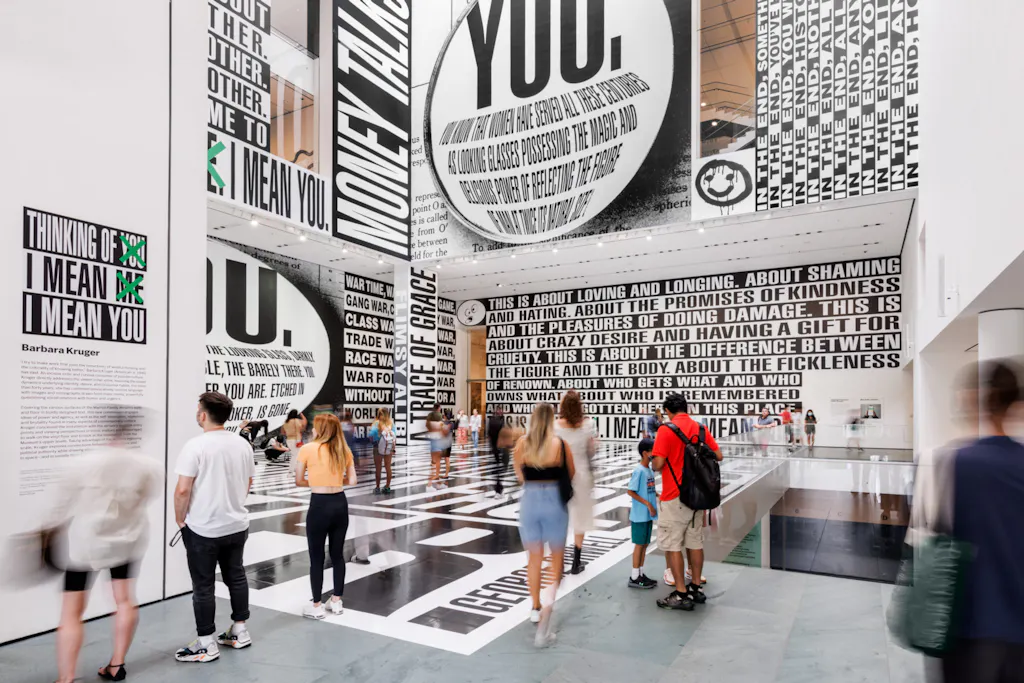
Thinking of You, I Mean Me, I Mean You channels the screen of a virus-infected computer: suddenly the screen lights up with disembodied, liberated windows and pop-ups vying for your attention, intrusive, unwanted, but also sneakily exciting. Barbara Kruger’s text-based installation consists of self-adhesive vinyl sheets laminated on almost every surface of the Donald and Catherine Marron Family Atrium, including the floor. The accusatory “You” is the largest word in Kruger’s poetic slogans and mantras. You are not innocent. What does Barbara Kruger say that you have done? Well for one thing:
You. You know that women have served all these centuries as looking glasses possessing the magic and delicious power of reflecting the figure of man at twice its natural size. (After Virginia Woolf).
And:
You. You are being seen. Caught in the mind’s eye. Caught in a world in shambles. This thing called “You.” This thing called “Me.” In this moment. In this place. Right Now. Come closer.
Until finally, you actually are dissolved by the artist herself:
You. You are here, looking through the looking glass, darkly. Seeing the unseen, the invisible, the barely there. You. Whoever you are. Wherever you are. Etched in memory. Until you, the looker, is gone. Unseen. No More. You too.
This is a show made for selfies, and that’s the point – putting a finger on the pulse of what defines, or divines, human culture at the current moment is what a good artist is supposed to do. Kruger’s words engage with the idea of the text, the tweet, the doodle, the pop-up – a kind of riotous cascade of politically triggering thoughts, words, intentions, and implications; oriented vertically:
A trace of Grace,
A Tragic Error,
A Smug Embrace,
A Flimsy Alibi
Or horizontally:
War time, war crime, war, gang war, civil war, class war, bidding war, trade war, cold war, race war, world war, war for peace, war without end, war for a world without women, war for me to become you.”
And even underfoot:
If you want a picture of the future, imagine a boot stamping on a human face forever,” George Orwell.
On top of the multidirectional data streams crawling up and down the walls, most of the viewers were engaging with their own and others’ smartphones to further mediate the artist’s gargantuan piece. It wasn’t easy to gauge whether they were reading the text or just enjoying the spectacle of words coming at them from every direction – it might be that the artist intended the dire meanings of her words to simply sink in over time and multiple viewings of these selfies. Kruger’s immersive installation resonated with other installations in the museum: while her work is almost obsessively current, she does share her notions of formal spatial composition with artists as varied as Matisse, Nancy Spero, and Jacob Lawrence.
Nancy Spero’s immersive and diagrammatic work Notes In Time (1970s) plays with legibility and retards the pace of viewing in order to force a more careful reading. Spero alternates different fonts, printing techniques, and media in order to capture the eye. In bright red her text begins with:
Then there are mythopoetic interpretations:
“Throughout Male Literary History, Gorgons, Sirens, Mothers of Death and Goddesses of Night Represent Women Who Reject Passivity and Silence.”
Or in different languages, grim fantasies:
“Murder Hope of Women.” (Oskar Kokoshka, 1911)
And there is also a substantial quantity of smaller texts – unlike Kruger’s piece which is quick to encompass, one could spend an hour or two with Spero. These printed texts are glued down, stencilled and printed on long scrolls and interspersed with drawings closely mimicking the standardised poses and body types of ancient Egyptian visual culture. Like Spero's and Kruger’s texts, Egyptian Hieroglyphs could move up and down, backwards and forwards; an immensely versatile writing system that could be employed to great aesthetic purpose. Like Kruger, Spero commandeers our body, more gently though, nudging us around the room, rather than jerking our head around as Kruger's works are prone to do.
Kruger’s atrium installation is perforated at several levels by a variety of windows and landings, offering multiple viewpoints. We can read the large text from George Orwell writ large on the floor, which we were just standing on, hopping uncomfortably back and forth from letter to letter, trying to make out the whole passage. Like Spero, Kruger is making us read in different ways – Notes in Time works diagrammatically, temporally, and as a collage of form, while Kruger is more about scale and vantage point; up close, far away. Walking up to the third floor of the museum and sitting in Matisse’s immersive paper cut-out installation for his swimming pool, from 1952, we see an odd bedfellow to Kruger’s exercise in destabilising architecture. While Kruger has placed a variety of two-dimensional elliptical and circular forms, large enough (sometimes two or three stories high) to interfere with the linearity of Tanaguchi’s architecture, Matisse similarly disrupts the flatness and linearity of his pool and jogs the movement of the eye. The room is floor-to-ceiling brown. A beige band runs horizontally at shoulder height: ostensibly the zone within which Matisse’s blue semi-figural cutouts will reside. But they don’t. They swim, soar, kick, and flip from this band, though some stay tensely within the lines. Like Kruger, Matisse toys with the notion of following the rules of linearity and containment: in one brief section of his collage, he creates a wholly inadequate bump-out for his frenetic blue shapes. This exception merely proves that they cannot be contained. Jacob Lawrence’s The Migration Series (1940-41) is a much more traditional cycle of images narrating the history of the movement of black Americans out of the south, starting with the First World War. The series of 30 images on display (of a total of 60) are stark and simple, and they gently flow along the wall, each with a text that explains the often highly symbolic and ritualised imagery in the drawings. In image 42 a police officer forms a human X, blocking off a rectangle, a waiting room or police truck, containing two black figures. The text reads:
Of all four installations, Lawrence’s is the least spatial but is arresting in its literal storytelling and its measured conceptual rhythm for each image. With the exception of Matisse, the installations are all political and use the weighty presence of the artist intruding into the real space of the viewer as a means to impress the importance of the message. Kruger is direct, confrontational, and perhaps to the benefit of the importance of her message against fascism, corruption, and control, ultimately hopeless. Perhaps after circulating from phone to phone and being reposted from Instagram-story-to-feed-to-story again, maybe it will eventually sink in. One can only hope.
In the end, something else begins
In the end, you’ve had your chance
In the end, you win or you lose
In the end, history happens
In the end, nothing matters
In the end, all is forgotten
In the end, anything goes
In the end, you disappear
In the end, Lies prevail
In the end, anger fades
In the end, hope is lost.
Barbara Kruger: Thinking of You. I Mean Me. I Mean You
16 July 2022 - 02 January 2023. MoMA, New York
Read more
Listen to audiocasts
 11 min 53s